December 19, 2011

What is Jeopardy?

I did better than I thought I would during the jeopardy games. The majority of the questions that I was getting wrong had to do Islam and the majority of the questions that I got right had to do with China.

What Yerim Got Wrong: 
A: The two most important deities in the Hindu Pantheon.
Q: Who are Vishnu and Shiva?

A: The name of the ship that began to use the lateen sail (triangular sail).
Q: What is a dhow?

A: This administration used Persian techniques of statecraft.
Q: What is the Abbasid administration?

A: The Byzantine Empire used this since it placed an imperial province under the jurisdiction of a general because they provided military defense and handled civil administration.
Q: What is a 'theme' system?

A: This Frankish ruler is credited for saving the Roman Catholic church.
Q: Who is Clovis?


December 15, 2011

eggs benedict

"The Rule"
4. Monasteries that followed "Benedict's Rule" could be very useful institutions because enforcing the rules everyone is very controlled and tractable. Such strict rules such as 57. to apply oneself frequently to prayer and 63. to love chastity keeps the people under control. Another reason that the monasteries could be useful is because despite the harshness and lack of freedom the rules assert, the citizens are taught valuable lessons and live to be "good, model citizens". 3. then not to kill, 4. not to commit adultery, 5. not to steal, 6. not to covet, 7. not to bear false witness all encourage and pretty much forces one to become a moral citizen.

5. Socially, it is evident that these people lived in fear 24/7 365 days a year. Rules 44 & 45 (to fear the Day of Judgment & to be in dread of hell, respectively) exhibit such fearful behavior and the Rules definitely fostered this fear, perhaps to have greater control over the people. I can see the government using these rules to their full advantage and scaring the pants off of the people to coerce them into following orders. Economically, I think that the rules could have benefited society. With the fear and love for God that the monasteries encourage, everything is to be done for God. This could be motivational and make society work harder. The paragraph on "Of the Daily Manual Labor" frowns upon laziness and clearly these people were always out and about, getting things done. The Rules create a productive society who fear being lazy since if you are, you go to hell. oh, that's exciting.

December 6, 2011

The Fruit of the Gods

I liked the poems because I felt like that they flowed very well and was very rhymeish. I think that the poems reflected Indian society brcause they were very religious and reflected the caste system. "The Plums Tasted" talk about a poor girl who was in the bottom of the caste system. "The Pot is a God" talks about how the gods are one god.

November 22, 2011

P-O-E-T-R-Y... & repeat

Tang Poetry
- The poetry from the Tang empire were interesting to read because each other the three poets had a different passion. Li Bai wrote mostly about the state of drunkenness while Du Fu was a realist who wrote about the harsh reality of life and how it affects relationships. Wang Wei wrote about nature and his poetry was very serene. I enjoyed all the poems especially Wang Wei's "A Green Stream"  because it was very calming and created a lovely visual imagery. I also liked Du Fu's "Alone in Her Beauty" for its striking realism and candidness and how he portrays human emotions so beautifully. Each of the poets had a distinct style of writing but there were some common themes. Both Li Bai and Du Fu write about being drunk. All three have the presence of nature in their poems. I think that the poems reflect Tang society well because this art of poetry gives us a glimpse of the social life back then and what things were exciting or devastating. I can sense that the Tang society liked to celebrate but also had political or economic troubles. It is also evident that nature was very prominent in their culture.

Song Poetry
- I also enjoyed Song poetry a lot mostly because it focused so much on nature which is always nice to read about. All three poets talk about nature which must play a prominent role in this culture as well as the Tang culture. Mei Yaochen and Li Yu both write about a woman. Like Tang poetry, some aspects of Song poetry (Su Shi) mention drinking. I think that the poetry reflects the society well but I think that Tang poetry reflected its society better. The poems give me a sense to more of what the individual beliefs were rather than the society as a whole. For example, I can sense that Su Shi has a somewhat degrading tone towards his newborn son because he wants him to be born ignorant.

November 13, 2011

Conversions of Two Important Men

Both Prince Vladimir and Constantine converted to Christianity during the course of their lifetime. Although how and why they converted are different events, their legacies are both great.
Prince Vladimir was what you would call a hard-core partier... but he wanted to unite his kingdom with a common religion. In something similar to auditions for a play or musical, he had scouts check out different religions. Both Islam and Judaism did not make the cut because of their dietary restrictions. The man liked to eat. The final contestants were Roman and Eastern Christianity. A few of his scouts visited the Church of the Holy Wisdom in Constantinople and were amazed. They told of how great the beauty and wonder was which in turn made the decision for Vladimir. The beauty was what bought him over. He converted to Orthodoxy and not only gained a unified nation, but also a wife by the name of Anna.
Constantine's conversion led to Vladimir's. So I suppose that these two events are similar events in history. They both wanted a better kingdom and by converting, they did obtain a larger, better kingdom. Constantine's desire to win a war led to his religious dreams and revelations which in turn made him convert. Both men spread Christianity and made it more widely known.

November 8, 2011

Art from So Far Long Ago

trends of the architecture:
- tall, rectangular buildings with rectangular windows
- domes
- peaks/ towers
- tall, rounded windows
- barely any flat roofs, the roofs are curved

is it distinctive/unique?: 
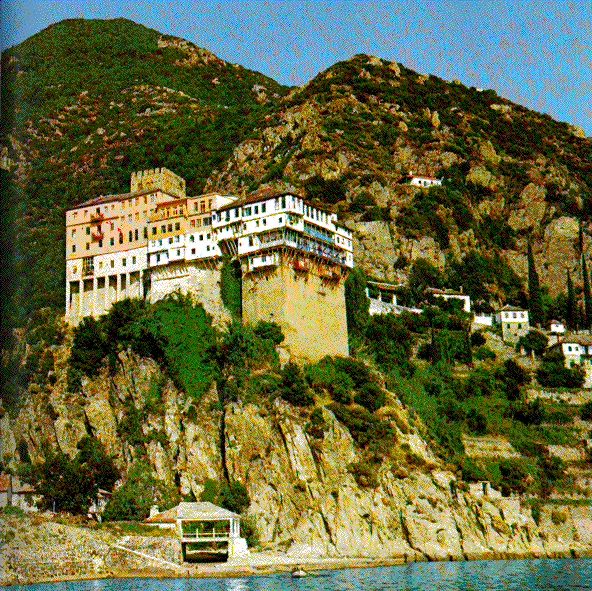
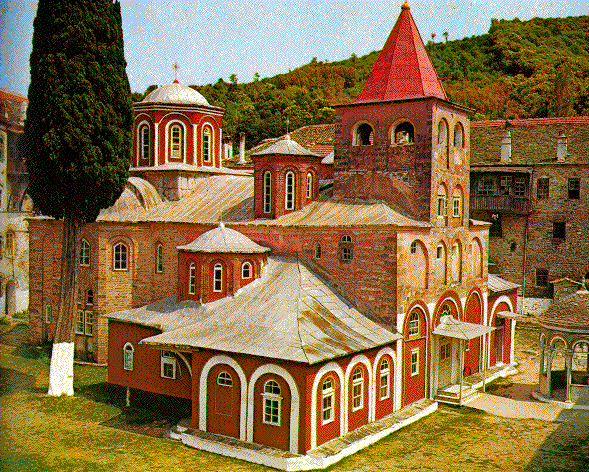
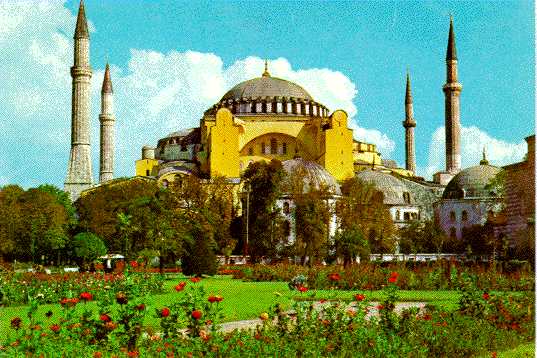
The architecture is definitely distinctive to a certain point. I imagine that one can look upon a picture of a building emphasized by domes and long windows and categorize it as something of the Byzantine nature. The architecture that I looked at were either tall, rectangular buildings such as Dionysiou and Simonas Petras; or they were marked by domes and rounded windows such as Philotheou  and Hagia Sophia.

functional? decorative? all of the above?
Byzantine architecture is very decorative but I also think that it was functional in a way. The churches and monasteries are absolutely breath-taking and beautiful. It is clear that the artists and architects had beauty and wonder in mind when they built them. The buildings were functional also because the churches and monasteries housed people who went there to worship and some are still standing today.


influenced American architecture?:
There are traces of Byzantine architecture in today's American architecture. This is evident in the numerous tall rectangular buildings that have taken over the country. The domes are as abundant especially on government buildings such as the Capitol Building's dome.

November 7, 2011

Take Me Back to Constantinople; Now it's Istanbul, Not Constantinople

Document 1: written by a Jewish rabbi named Benjamin of Tudela who is writing to the Jews. He writes about the glorious wonders of Constantinople but how the Jews are treated poorly.
Document 2: written by Robert of Clari to the general public about the riches and wonders of Constantinople and how when it was captured its captors were amazed by its wealth and beauty. The document talks about the many cathedrals maybe to suggest the importance of religion to the Byzantine Empire.
Document 3: written by Nicetas Choniates to the general public about how the Latins went into Constantinople and destroyed the art.
Document 4: The map is not very trustworthy because the scale is not credible and the buildings look block and too large. There are few cathedrals to show how religion was important. The land is surrounded by water and watch towers to illustrate how defensive they were and ready for attacks.
Document 5: The photo of the interior of Saint Sophia Cathedral shows the new type of art and architecture that was stirring in the Byzantine Empire.
Document 6: written by George Acropolites to the world and is a third-party narrative about the journey of the emperor Michael VIII Palaeologus. The emperor performed religious ceremonies and gave the patriarch the throne.
Document 7: written from a viewpoint of a citizen and talks about the great things the Venetians have done. It also talks about the special benefits and privileges the Venetians have. This document is not very trustworthy because it only mentions Constantinople for its trading port.

I think that Document 1 and 2 are the most credible documents because they both describe Constantinople in great detail from the wealth and riches to the cathedrals, even specific ones such as Saint Sophia. Many of the other documents do not discuss Constantinople in this much of detail or barely mentions it.